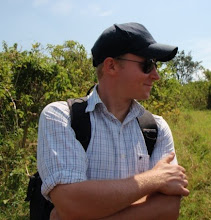
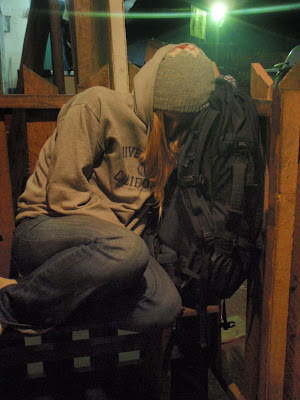
 Pictured Here: (From Top to Bottom)
* Brandon takes a coconut to the face in Dar es Salaam, Tanzania.
* Trena, on the train from Dar es Salaam to Mbeya, Tanzania, takes in the view.
* Nora hangs out at 'Big Blue Star Backpackers,' the lodge we stayed at in Nkhata Bay, Malawi.
* Me, Emmett, sips some 'Shake-Shake' - a local alcoholic drink in Malawi.
* Malcolm looks out over Lake Malawi in a dugout canoe.
* Kate gets some must needed rest while waiting for a bus in Mzuzu, Malawi.
**********
Malawi Trip: Play-by-Play
**********
Saturday, August 7th
*
The trip began. Malawi does not border Rwanda, so we had to go through Tanzania. Personally, I had no problem with this; I still had my Tanzania Visa and I wanted to see more of Dar es Salaam anyway.
*
We knew that going to Malawi through Dar was not the most time efficient move, but we knew that if we went to Dar, we could then get a train to Mbeya (a Tanzania/Malawi border town). Excited about the prospect of taking a train through South Tanzania, we didn't have a problem with going the long way around.
*
The bus we got on that morning was going to take us directly to Dar. It was going to take like 36 hours nonstop to get there, but it was going to get us there. Some of us took the same bus to get to Dar when we visited Zanzibar late last year, so we knew what we were getting into. (When I say 'we' here I mean me, Malcolm, and Brandon, so the girls just had to trust us.)
**********
Sunday, August 8th
*
The bus had left very early Saturday morning. We got into Dar around 11am on Sunday. The bus ride was kind of a blur. All I remember was falling in and out of sleep very often, going down some very bumpy roads at a ridiculous speed, and, consequently, praying for my life - so, I pretty much had the same experience that I had last year when I took the bus to Dar.
*
We made it out of the Dar bus station and checked into our rooms at the local YMCA. We unloaded our gear and explored the city a bit. We didn't get much exploring done, though. It was Sunday AND Ramadan was starting in another couple of days, so a lot of places were closed. However, it did feel great to finally be off of that bus!
**********
Monday, August 9th
*
We spent the day hanging around Dar and planning the rest of our traveling specifics to Malawi - the end destination being Nkhata Bay, Malawi. An important part of this planning was buying tickets, which required money, of course.
*
Here was my situation: I had about $400 American dollars that my folks had given me, but I still had about $200 Rwandan Francs to convert into Tanzanian Shillings. I did not convert my Francs into Shillings at the Rwanda/Tanzania border because I thought that the exchange rate would be better in Dar.
*
When we got to Dar, I learned that I made a big mistake. There was ONE place in Dar that could exchange Francs into Shillings and, guess what, they were not buying Rwandan Francs that day. We spent the better part of this day running around town, trying to convert Francs to Shillings. We must have went to 20 different For-Ex offices. Brandon and I even went to the Rwandan embassy in Tanzania to find someone to help us out. It was a long shot, but we were that desperate.
*
Every For-Ex gave us the same answer: 'No.' And when Brandon and I went to the embassy we didn't get any help. The embassy was closed in celebration of the presidential election happening in Rwanda. The guard merely wished us luck and sent us on our way.
*
I was so hell-bent on getting my money changed over this day, that I didn't get to enjoy the city. I was kind of upset. I mean, how can a country that borders another country not be able to convert its currency!? I can convert Shillings to Francs anywhere in Rwanda, which is what I should have done in the first place, I guess. Anyway, after an exhausting day of running around, we had dinner at a 'Subway' that was close to our rooms at the YMCA. The meal was delicious.
**********
Tuesday, August 10th
*
We spent Tuesday morning looking for a place to exchange Francs into Shillings. Before we started the adventure, however, I had resigned myself to the fact that I was not going to be able to convert my Francs.
*
This trip was not starting well for me; instead of having $600 for this trip, I now only had $400. Was it even possible to do this trip with only $400? I was going to find out.
*
After briefly searching town for a place to change money, we made our way to the train station in Dar. We hung out at the station for a few hours, got on the train at about 5pm and started for our next destination: Mbeya, Tanzania.
**********
Wednesday, August 11th
*
The train was great. We reserved a second class car that fit the six of us pretty well. The beds folded out from the wall and the train staff provided us with some blankets and sheets. This was a good thing because Tuesday night was pretty cold, actually. On a side note: we were told that the train went through one of the national parks in Tanzania, but it was too dark to see anything when we went through it.
*
We arrived in Mbeya on Wednesday afternoon. We got off the train and got public transport to the Tanzania/Malawi border. We crossed the border into Malawi that afternoon and made it as far as Nkaranga, a Malawi town a few hours South of the border.
*
Once in Nkaranga, Malawi we got a place to stay and went to dinner. After dinner we called it a night.
**********
Thursday, August 12th
*
It wasn't until the next day that one of our party members realized that she had left her purse at the restaurant. An employee at the restaurant had brought the purse back in the middle of the night. Nothing was missing...except for $350! We went back to the restaurant to investigate where the missing money went, but our leads were not promising. Luckily she was able to get some money wired to her a few days later, so it wasn't a horrible emergency, just an expensive inconvenience.
*
We left Nkaranga well rested, but a little bitter about losing some of our funds. We pushed on farther South, however. We caught public transport to Mzuzu, Malawi and from there we caught another bus to Nkhata Bay, Malawi - our final destination!
*
Just a quick geography note. Nkhata Bay is right on Lake Malawi and is about half the distance between the Malawi/Tanzania border and Lilongwe, Malawi's capital city. I provided a map on the previous blog entry; you might be able to find Nkhata Bay's location.
*
We arrived into Nkhata Bay just after dark. We checked into our lodge, 'Big Blue Star Backpackers,' and hit the lodge bar immediately. We spent the night drinking and, let me tell you, we needed the release. At this point we had been on the road almost nonstop since Saturday morning; we were exhausted! We made great time, however; we got into the Bay a full day earlier then we thought we would. So, to celebrate this small achievement, we had a drink or two.
**********
Friday, August 13th
*
We didn't really do much on Friday. I don't know what everyone else did, but I slept in. After catching up on sleep, I did my laundry and walked into town to explore the market.
*
I was really blown away by our arrangements at Nkhata Bay. The backpackers lodge was really cool. It was right on Lake Malawi and the lodge had space for tents, if you wanted to camp, and it also had dorm rooms and smaller bungalows. The bungalows were the most expensive arrangement at about $7-$8 a night; we rented three of them.
*
The lodge also had a full bar, restaurant, kitchen, beach, computers with Internet access, and a lounging area (complete with T.V., cable, DVD player and DVDs). All areas were open to the guests. They also had canoes, rafts and snorkeling gear to rent for free; it was great.
**********
Saturday, August 14th and Sunday, August 15th
*
Honestly, these day were really the same. We just hung out and relaxed; nothing crazy to report. We did meet some Peace Corps Malawi Volunteers on Saturday and on Sunday one of them took us to a local beach.
**********
Monday, August 16th
*
This day was pretty eventful. I ate my first Chambo (a type of fish) and had my first drink of Shake-Shake (a local alcoholic drink). Both were delicious. Well, the Shake-Shake was pretty bad for the first couple of sips, but, like all alcohol, it doesn't taste as bad the more you drink.
*
The backpackers' lodge organized a boat trip that day that took us to another beach further down Lake Malawi. The boat trip was cool and the beach was beautiful. When we had first arrived to Malawi, it was very cold and very windy. Monday was a bit warmer and definitely not as windy. Therefore, the conditions were great for going out on the lake.
*
The conditions were also great for feeding the Fish Eagles. These are just what they sound like - big Eagles that eat fish. I had seen Fish Eagles at Akagera National Park in Rwanda, but I had never seen one as close as I had this day.
*
We were out in the boat and one of the local guys that was maneuvering the boat told his partner to cut the engine. So we sat in this boat for a little while and the one boat guy began putting two little fish on each end of a stick. He then began to whistle to the Fish Eagles, calling their attention. Apparently, feeding the Fish Eagles is something that is done pretty often by the employees of the backpackers lodge. The Eagles are 'trained' to come at this call because they know that they are going to be fed.
*
It was pretty cool. Once a Fish Eagle was spotted, the guy whistled very strong, then held up the stick with the two small fish on either end and threw it a few yards from the side of the boat. The Fish Eagle would see the fish, dive down from the trees, and snag the fish-stick (literally). The bird would then fly back to the trees and eat its gift. It was really cool to see them up close; they have an incredible wingspan. We fed them as we were going to and coming from the beach.
**********
Tuesday, August 17th and Wednesday, August 18th
*
These days were fun, but they consisted of pretty much the same activities: eating and drinking. Ha! I ate so much fish these two days and I drank so many Carlsberg beers - I know I gained weight on this trip.
*
Just a side note: Carlsberg is really the only beer you can find in Malawi; the company has a 99 year production lease or something like that. One of the PC Malawi guys was explaining it to me, but by then I had too many Carlsbergs and I couldn't keep up with/remember much of the conversation.
**********
Thursday, August 19th
*
This was our last full day in Malawi. What did we do? We ate, drank, and hung out on the beach, of course. This time, however, we borrowed the lodge's raft and stayed at the lodge's beach. In the afternoon we went into town and bought more Shake-Shake and Power. Power is a popular hard alcohol and it is most commonly sold on the street in little packets. We went into town and bought two full bottles of it along with some drinks to mix it with. That was a great afternoon/evening.
**********
Friday, August 20th and Saturday, August 21st
*
I woke up that Friday morning feeling a bit sick...okay, okay...hungover. At any rate, we packed up our gear that afternoon and checked out. Well, all but one of us. Brandon decided to stay another day or two and hang out, but the rest of us needed to get back.
*
We left Nkhata Bay and made it to Mzuzu that afternoon. The bus we were to take from Mzuzu was suppose to leave at 12 midnight, but it didn't show up until 2am! It was soooooooooo cold waiting at that bus station for all those hours...so damn cold. But we survived.
*
We made it out of Malawi on Saturday and we were pretty much taking the same route we took to get to Nkhata Bay, but in reverse. We would have done it exactly like that too, but we got stuck in Mbeya, Tanzania. The train we were going to take that afternoon from Mbeya to Dar es Salaam was delayed until the next morning. So, we had two options, really. We could sleep at the train station and take the train back to Dar the next morning OR we could stay the night in town and take a 10-12 hour bus to Dodoma. We chose the second option.
*
Dodoma is Tanzania's capital city. It is North of Mbeya and closer to Rwanda than Dar. In fact, if we went to Dar we would be going a bit in the opposite direction. We thought that maybe this was for the best. Skipping Dar, we thought, would shave some time off of our trip back too.
**********
Sunday, August 22nd
*
We left Mbeya and went North to Dodoma, Tanzania. This bus ride was pretty cool because it went through one of the national parks and we did see some animals, specially Giraffes, Baboons, Warthogs, and Antelope.
*
We made it to Dodoma with no problems and we were thinking we could get a bus from Dodoma to Rusumo, the border town of Rwanda/Tanzania. Wrong. We got to Dodoma and could only get a bus to Kahama, a city closer to Rwanda but still 5-6 hours East of Rusumo. This bus to Kahama, however, didn't leave until the next day, so we stayed the night in Dodoma.
**********
Monday, August 23rd and Tuesday, August 24th
*
Exhausted reading this thing yet? Try living it.
*
Anyway, we made it to Kahama and spent the night. On Tuesday we got up, took a bus from Kahama to Rusumo, and took a bus from Rusumo to Rwamagana. The End.
***********
Notes:
*
Though I felt as though I spent just as much time in Malawi as I spent getting to and from Malawi, it was still a pretty awesome trip. The transportation wasn't all that bad, really. The fish in Malawi was delicious, the beaches were beautiful, and the people were very chill. I would totally visit Malawi again, though I want to go with more money in my wallet. I only spent like $400 total - that includes travel and everything. I was never able to change those Francs into Shillings. I didn't even try to convert my Francs into Kwacha (Malawi's currency); I knew it would have been a lost cause and I wasn't about to waste any more of my trip worrying about it.
*
I know it seems like all we did was eat, drink, and travel, but some stories you just can't translate onto a blog. The story just doesn't make sense unless you were there and a part of it; I tried writing some of them out, but they didn't come across as funny or as entertaining as they were for us. I suppose that is because I am not that strong of a writer.
*
Just another update before I sign off: the construction at the health center is finished apparently. I heard through the grape vine that the health center in my village now has running water in three of its facilities. I have heard that everything went so well, that they want to get the rest of the health center set up with plumbing. Giddy up!